
Aitomic research brief
Quick overview
A beginner-friendly but technically honest guide to the hierarchy of AI, machine learning, and deep learning, including why the terms are nested and how to use them correctly in 2026.
Who this is for: Non-technical readers, students, operators, and teams who hear AI terms often and want to use them accurately.
Why this matters now
In 2026, AI terminology confusion creates bad decisions: teams buy tools without understanding the method, and readers mix up the goal (AI) with the techniques (ML and deep learning). Getting the hierarchy right improves both business conversations and technical evaluations.
Key figures at a glance
| Hierarchy model | AI > ML > Deep Learning |
| Compute intensity trend | Deep learning commonly relies on GPUs for modern training workloads |
| Explainability tradeoff | Rule-based and simpler ML models are often easier to explain than deep neural networks |
| 2026 nuance | Small Language Models (SLMs) are rising for specialized, efficient deployments |
The Matryoshka doll concept (the easiest mental model)
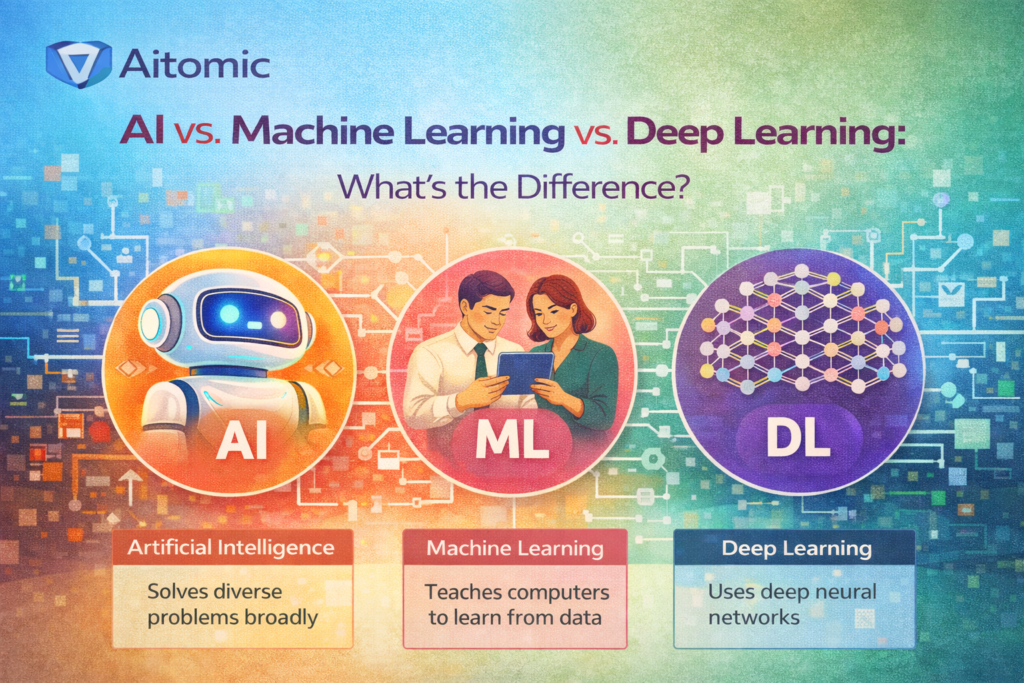
The cleanest way to understand the difference is a nesting-doll model: Artificial Intelligence is the biggest doll, Machine Learning sits inside it, and Deep Learning is a smaller, specialized core inside machine learning.
People often use the terms as if they mean the same thing because modern consumer AI products are frequently powered by machine learning and deep learning. But the hierarchy matters when you are evaluating how a system works, how much data it needs, and how explainable it is.
If you remember only one thing: AI is the broad goal, ML is one major method, and deep learning is a powerful ML engine that shines in complex pattern tasks.
Artificial Intelligence (the goal): making machines act intelligently
Artificial Intelligence is the broad field of making machines perform tasks that look intelligent: reasoning, planning, pattern recognition, optimization, and decision support.
Not all AI is machine learning. Earlier and still-useful AI systems include rule-based systems (if-then logic), search algorithms, heuristics, expert systems, and optimization engines. In many businesses, these systems still power routing, rules engines, and workflow automation.
This is why ‘AI’ should be treated as the umbrella. The field includes both classic logic-heavy systems and modern data-driven systems.
- Rule-based AI: explicit instructions and business logic.
- Search/optimization AI: finding good decisions under constraints.
- Machine learning AI: learning patterns from examples.
- Hybrid systems: ML predictions plus rules, approvals, and human review.
Machine Learning (the method): show examples instead of coding every rule
Machine learning is a method where systems improve performance by learning from data. Instead of programming every rule by hand, you show the system examples and let it infer patterns that help it predict or classify new inputs.
This was a major shift in software engineering. It works especially well when writing explicit rules would be too complex or brittle, such as spam detection, fraud detection, recommendation systems, or forecasting.
A useful business interpretation: ML is often the move from deterministic rules to probability-based decision support.
- Supervised learning: training on labeled examples (for example, spam vs not spam).
- Unsupervised learning: finding structure in unlabeled data (for example, clustering customer behavior).
- Semi-supervised and self-supervised methods: using partial labels or structure to reduce labeling costs.
Deep Learning (the engine): neural networks for complex patterns
Deep learning is a specialized branch of machine learning that uses neural networks with many layers to learn complex representations from data. It is especially powerful for language, images, speech, and other high-dimensional patterns.
Deep learning often performs best when you have strong compute resources (modern GPU/accelerator stacks) and large datasets or pretrained models. That is why NVIDIA is frequently mentioned in deep learning discussions: accelerators became central to training and serving modern DL systems.
The tradeoff is that deep learning models can be harder to interpret than simpler models. They may be extremely useful and accurate while still being difficult to explain at a granular level.
The 2026 nuance: smaller, specialized deep-learning systems (SLMs)
A major 2026 discussion is not only ‘bigger models.’ It is also smaller, specialized models deployed for narrower tasks, often with better cost, latency, and governance characteristics.
This is where Small Language Models (SLMs) matter. Teams are increasingly asking whether a smaller domain-tuned system can deliver enough quality for a specific workflow at lower cost and with better control than a huge general model.
This does not replace large models. It expands the deployment choices and makes the AI/ML/DL conversation more practical.
Why explainability becomes harder as systems become more complex
One reason this distinction matters is explainability. If a system is rule-based, you can often inspect the logic directly. If it is a simpler ML model, you may still get interpretable signals. With deep learning, you often gain performance but lose transparency.
This is the ‘black box’ concern discussed in both technical and public-facing publications. It does not mean deep learning is unusable. It means you need stronger evaluation, monitoring, and controls when the consequences of error are high.
In business terms, the deeper the model and the higher the stakes, the more important testing and governance become.
Comparative table: speed, data needs, and explainability
| Primary scope | AI = the broad goal of making systems act intelligently; ML = one method; DL = a specialized ML approach using neural networks. |
| Data requirements | Rule-based AI can use explicit logic; ML usually needs labeled/unlabeled examples; DL typically needs much more data (or high-quality pretraining + fine-tuning). |
| Compute needs | Classical AI/ML can run on modest compute for many tasks; DL often benefits from GPUs and larger training infrastructure (NVIDIA context in modern deep learning stacks). |
| Explainability | Rule-based systems are easier to inspect; ML can be partly explainable depending on the model; DL is often more opaque (‘black box’) in practice. |
| Best use cases | AI (broad) for automation/decision rules; ML for prediction/classification from data; DL for speech, vision, language, and complex pattern tasks. |
| 2026 nuance | Small Language Models (SLMs) and domain-tuned models combine deep learning efficiency with narrower, specialized deployments. |
This is a decision table, not a rigid rule. Real-world systems often combine these approaches (for example, deep learning for predictions plus rule-based business logic for guardrails and approvals).
How to think about this topic without hype
The most reliable way to use this guide is to treat it as a decision framework for AI vs machine learning vs deep learning, not as a fixed prediction. AI markets, products, and public narratives move quickly, so your advantage comes from having a repeatable way to evaluate claims.
For this topic, start with a workflow-based test and a source-based verification pass. Separate trend narratives from task-level evidence, and verify the most important claims in primary sources before acting.
Common mistakes to avoid
- Using AI trend content as a decision shortcut without checking the underlying sources.
- Confusing search interest or social buzz with reliable evidence.
- Treating one tool, model, or headline as representative of the whole field.
What to monitor over the next 12 months
- Updates to primary reports, regulations, and official pricing pages.
- Shifts in user behavior (search, adoption, and trust patterns).
- Where practical workflow evidence contradicts popular online narratives.
What the data signals (and what it does not)
Most AI articles list figures without explaining how to use them. This section translates the headline numbers into decision signals and shows where readers often overinterpret the data.
How to read the headline figures
Hierarchy model
Hierarchy model = AI > ML > Deep Learning. Use this as a directional signal from Mirchandani (2026), Coursera (2025), not as a standalone conclusion. The practical question is what behavior it should change in your workflow, budget, or risk controls.
Compute intensity trend
Compute intensity trend = Deep learning commonly relies on GPUs for modern training workloads. Use this as a directional signal from Coursera + industry practice / NVIDIA context, not as a standalone conclusion. The practical question is what behavior it should change in your workflow, budget, or risk controls.
Explainability tradeoff
Explainability tradeoff = Rule-based and simpler ML models are often easier to explain than deep neural networks. Use this as a directional signal from MIT Technology Review + MIT News explainability references, not as a standalone conclusion. The practical question is what behavior it should change in your workflow, budget, or risk controls.
2026 nuance
2026 nuance = Small Language Models (SLMs) are rising for specialized, efficient deployments. Use this as a directional signal from 2026 trend framing across industry reporting, not as a standalone conclusion. The practical question is what behavior it should change in your workflow, budget, or risk controls.
How to put this into practice
This is the implementation layer. The goal is to turn the topic into a repeatable workflow, pilot, or decision process you can run in the next 1-4 weeks.
Phase 1: Define the decision
- Write the exact decision this article should help you make.
- List the top claims you must verify before acting.
- Choose primary sources you trust for this topic.
Phase 2: Test in context
- Run a small real-world test instead of staying in abstract debate.
- Compare the result to your current workflow or assumption.
- Record what failed and what improved.
Phase 3: Operationalize
- Document the process that worked.
- Teach the workflow to the next person.
- Revisit the process as tools and policies change.
How this advice changes by context
The right approach depends on stakes, workflow complexity, and consequence of failure. Advice that is acceptable in a low-risk personal task may be unsafe in a regulated or customer-facing workflow.
Real examples and practical scenarios
These are decision-oriented examples to help you apply the topic in a real workflow instead of treating AI as a generic trend.
- Rule-based AI example: A workflow engine approves or routes requests using explicit if-then conditions and thresholds.
- Machine learning example: A fraud model learns suspicious transaction patterns from historical labeled data.
- Deep learning example: A neural network powers speech transcription or image recognition in a product experience.
- 2026 SLM deployment example: A company uses a smaller domain-tuned language model for internal policy Q&A instead of a giant general model.
What to do next: action checklist
- Use ‘AI’ for the umbrella category, not as a synonym for one technique.
- Ask whether a system is rule-based, ML-based, DL-based, or a hybrid.
- Match the method to the task, data, and explainability needs.
- Expect higher compute/data needs for many deep-learning use cases.
- Use stronger evaluation and governance when model explainability is low and consequences are high.
Questions people usually ask
Is all machine learning deep learning?
No. Deep learning is a subset of machine learning. Many useful ML systems use other model types and do not require deep neural networks.
Is all AI machine learning?
No. AI includes rule-based systems, optimization, search, and other approaches in addition to machine learning.
Why are deep learning models called black boxes?
Because their internal reasoning is often harder to interpret directly than simpler models or explicit rules, even when they perform well.
Sources used for this guide
This article was written as a practical guide using public reports, official documentation, and pricing pages. Pricing and product features can change; verify current details on the official pages before acting.
Figure sources used in this article
- Hierarchy model: Mirchandani (2026), Coursera (2025)
- Compute intensity trend: Coursera + industry practice / NVIDIA context
- Explainability tradeoff: MIT Technology Review + MIT News explainability references
- 2026 nuance: 2026 trend framing across industry reporting
Why these sources were used
- Mirchandani – AI vs Machine Learning vs Deep Learning: Master the Differences [2026] (https://mirchandani.ae/blogs/ai-vs-machine-learning-vs-deep-learning/) – Used for the hierarchy comparison framing and resource/data requirement distinctions.
- Coursera – Deep Learning vs Machine Learning: Beginner’s Guide (https://www.coursera.org/in/articles/ai-vs-deep-learning-vs-machine-learning-beginners-guide) – Used for beginner-friendly hierarchy explanation and differences in intervention/data/training.
- MIT Technology Review – The Dark Secret at the Heart of AI (archival reference) (https://www.technologyreview.com/s/604087/the-dark-secret-at-the-heart-of-ai/) – Used as an archival reference on deep learning’s ‘black box’ challenge (may require subscription/archive access).
- MIT News – Unpacking black-box models (https://news.mit.edu/2022/machine-learning-explainability-0505) – Used as accessible support reference on explainability and model understandability.
- Mirchandani – AI vs Machine Learning vs Deep Learning: Master the Differences [2026]
- Coursera – Deep Learning vs Machine Learning: Beginner’s Guide
- MIT Technology Review – The Dark Secret at the Heart of AI (archival reference)
- MIT News – Unpacking black-box models
Explore More on Aitomic
Related reads
- Adobe Firefly Review (2026): Pricing, Features, Pros & Cons
- AI and Data Privacy Risks in 2026: What Happens to Your Data and How to Use AI More Safely
- AI and Job Displacement in 2026: What Changes First, What Grows, and How to Adapt
- AI as a Search Engine in 2026: When to Use Chatbots vs Traditional Search
- AI for Mental Health Support in 2026: What It Can Help With, What It Cannot Replace
- Amazing Selling Machine Review (2026): Pricing, Features, Pros & Cons