
Aitomic research brief
Fast orientation
A practical guide to AI hallucinations, including causes, examples, and a repeatable verification workflow for teams and individuals.
Who this is for: Anyone using AI for research, writing, coding, customer support, or decision support.
Why this is worth understanding now
As AI becomes a default assistant for search, writing, and coding, hallucinations become a business risk. The cost of one confident wrong answer can be reputational, operational, or legal.
Data points worth tracking
| Public concern about AI | 50% more concerned than excited |
| o1 SimpleQA hallucination score (lower better) | 0.44 (disclosed example) |
| NIST guidance focus | Application-level hallucination reduction |
| Enterprise AI usage exposure | 78% use in at least one function |
What a hallucination actually is
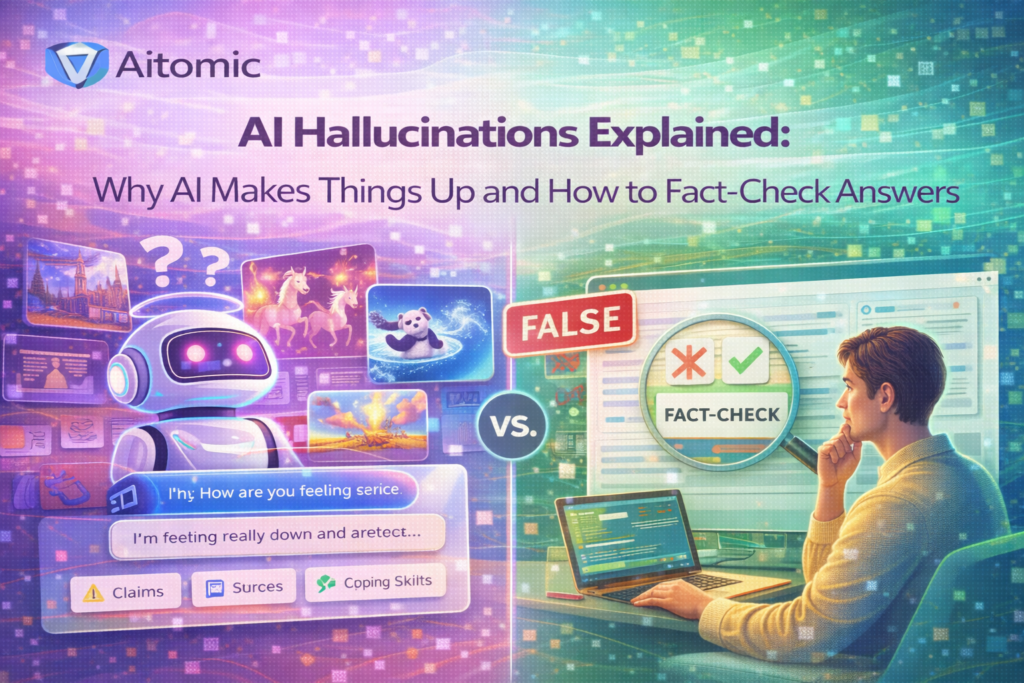
An AI hallucination is a fluent output that is false, unsupported, or fabricated. It may include invented facts, fake citations, wrong calculations, or incorrect summaries stated with confidence.
The hardest part is that hallucinations often look polished. That is why many users trust them until they verify details against a source.
Why hallucinations happen
Hallucinations are not one single bug. They can be caused by missing context, ambiguous prompts, stale knowledge, poor retrieval, weak instructions, or models optimizing for plausible completion instead of verified truth.
In production systems, the failure can also come from the surrounding application: no source display, no validation layer, weak prompt templates, or no escalation path when confidence should be low.
This is exactly why NIST frames hallucination reduction as an application design problem, not only a model-comparison problem.
The 5-step fact-checking workflow that scales
The goal is not to distrust everything; it is to verify the right things quickly. A simple workflow prevents both blind trust and slow overchecking.
- Step 1: Identify the claim type (fact, opinion, estimate, recommendation, code behavior).
- Step 2: Ask the AI to cite sources and show uncertainty or assumptions.
- Step 3: Verify high-risk claims in primary sources (official docs, reports, laws, product pages).
- Step 4: Compare 1-2 independent sources for important claims.
- Step 5: Keep a log of frequent hallucination patterns and update prompts/workflows.
How hallucinations show up in real work
In writing workflows, hallucinations often appear as invented statistics, outdated pricing, or fake quotes. In coding workflows, they show up as non-existent APIs, incorrect library usage, or subtle logic mistakes.
In business workflows, hallucinations can appear as confident but unsupported recommendations, especially when the model is asked to infer too much from too little data.
The risk increases when users combine speed pressure with low verification discipline.
How to reduce hallucinations without killing productivity
The most effective strategy is to move verification earlier in the workflow. Ask the model to separate facts from assumptions, request source-backed answers, and use structured outputs that make review easier.
For teams, create a rule: if the output will be published, sent to customers, or used for decision-making, it must have a verification step proportional to the risk.
Public interest is high, but the mood is mixed. Pew Research reported that many Americans describe themselves as more concerned than excited about AI, which means successful content in 2026 needs to answer practical questions and risk questions in the same article.
When you should not use AI answers directly
Do not use raw AI outputs as final advice in legal, medical, financial, or compliance decisions without qualified human review and primary-source verification.
This is not anti-AI. It is the same quality-control logic you would apply to a junior draft, an internet search result, or a copied spreadsheet formula.
Deep analysis: how to evaluate this topic without getting misled
The most reliable way to use this guide is to treat it as a decision framework for AI hallucinations, not as a fixed prediction. AI markets, products, and public narratives move quickly, so your advantage comes from having a repeatable way to evaluate claims.
For this topic, start with a workflow-based test and a source-based verification pass. Separate trend narratives from task-level evidence, and verify the most important claims in primary sources before acting.
Common mistakes to avoid
- Using AI trend content as a decision shortcut without checking the underlying sources.
- Confusing search interest or social buzz with reliable evidence.
- Treating one tool, model, or headline as representative of the whole field.
What to monitor over the next 12 months
- Updates to primary reports, regulations, and official pricing pages.
- Shifts in user behavior (search, adoption, and trust patterns).
- Where practical workflow evidence contradicts popular online narratives.
How to read the evidence behind the headlines
Most AI articles list figures without explaining how to use them. This section translates the headline numbers into decision signals and shows where readers often overinterpret the data.
How to read the headline figures
Public concern about AI
Public concern about AI = 50% more concerned than excited. Use this as a directional signal from Pew Research (Apr 2025), not as a standalone conclusion. The practical question is what behavior it should change in your workflow, budget, or risk controls.
Sentiment figures matter because trust affects adoption and content performance. In practice, readers and buyers now expect AI guidance to address risks and controls, not just productivity upside.
o1 SimpleQA hallucination score (lower better)
o1 SimpleQA hallucination score (lower better) = 0.44 (disclosed example). Use this as a directional signal from OpenAI o1 System Card, not as a standalone conclusion. The practical question is what behavior it should change in your workflow, budget, or risk controls.
NIST guidance focus
NIST guidance focus = Application-level hallucination reduction. Use this as a directional signal from NIST pilot profile, not as a standalone conclusion. The practical question is what behavior it should change in your workflow, budget, or risk controls.
Enterprise AI usage exposure
Enterprise AI usage exposure = 78% use in at least one function. Use this as a directional signal from Stanford HAI AI Index 2025, not as a standalone conclusion. The practical question is what behavior it should change in your workflow, budget, or risk controls.
Implementation playbook
This is the implementation layer. The goal is to turn the topic into a repeatable workflow, pilot, or decision process you can run in the next 1-4 weeks.
Phase 1: Define the decision
- Write the exact decision this article should help you make.
- List the top claims you must verify before acting.
- Choose primary sources you trust for this topic.
Phase 2: Test in context
- Run a small real-world test instead of staying in abstract debate.
- Compare the result to your current workflow or assumption.
- Record what failed and what improved.
Phase 3: Operationalize
- Document the process that worked.
- Teach the workflow to the next person.
- Revisit the process as tools and policies change.
How to apply this in different environments
The right approach depends on stakes, workflow complexity, and consequence of failure. Advice that is acceptable in a low-risk personal task may be unsafe in a regulated or customer-facing workflow.
What this looks like in real workflows
These are decision-oriented examples to help you apply the topic in a real workflow instead of treating AI as a generic trend.
- Content team: AI drafts a market overview and cites fake numbers; editor verifies every statistic against primary reports before publishing.
- Developer: AI suggests a non-existent library function; engineer checks official docs/tests before merging.
- Support agent: AI drafts a refund-policy answer using outdated rules; agent verifies current policy page first.
- Research analyst: AI summarizes a report but misses the methodology limits; analyst reads the methodology section before using the numbers.
Action checklist (what to do next)
- Treat all AI-generated figures as unverified until checked.
- Require sources for factual outputs and high-stakes recommendations.
- Use primary sources for product specs, pricing, laws, and policies.
- Separate drafting from decision-making in your workflow.
- Review recurring failure patterns and improve prompts plus process controls.
Common questions
Can hallucinations be eliminated completely?
Not completely. You can reduce them significantly with better context, retrieval, interface design, and human verification.
Are some models less likely to hallucinate?
Yes, models can differ by task and benchmark, but application design and workflow controls still matter a lot.
What is the fastest way to fact-check AI answers?
Check the highest-risk claims first in primary sources, especially numbers, dates, quotes, and policy details.
References and research notes
This article was written as a practical guide using public reports, official documentation, and pricing pages. Pricing and product features can change; verify current details on the official pages before acting.
Figure sources used in this article
- Public concern about AI: Pew Research (Apr 2025)
- o1 SimpleQA hallucination score (lower better): OpenAI o1 System Card
- NIST guidance focus: NIST pilot profile
- Enterprise AI usage exposure: Stanford HAI AI Index 2025
Why these sources were used
- OpenAI – OpenAI o1 System Card (https://openai.com/index/openai-o1-system-card/) – Used as an example of model hallucination benchmarking disclosure.
- NIST – Reducing Hallucinations in Generative AI Applications (Pilot Profile) (https://www.nist.gov/publications/reducing-hallucinations-generative-ai-applications-pilot-ai-profile) – Used for hallucination risk-reduction practices.
- NIST – AI Risk Management Framework (https://www.nist.gov/itl/ai-risk-management-framework) – Used for governance, risk, and deployment controls.
- Pew Research Center – How Americans view AI and its impact (2025) (https://www.pewresearch.org/short-reads/2025/04/03/how-americans-view-ai-and-its-impact-on-people-and-society/) – Used for public sentiment and concern/excitement balance.
- Stanford HAI – AI Index Report 2025 (https://hai.stanford.edu/ai-index/2025-ai-index-report) – Used for investment, adoption, and broad market evidence.
- OpenAI – OpenAI o1 System Card
- NIST – Reducing Hallucinations in Generative AI Applications (Pilot Profile)
- NIST – AI Risk Management Framework
- Pew Research Center – How Americans view AI and its impact (2025)
- Stanford HAI – AI Index Report 2025