
Aitomic research brief
What this guide covers
A practical guide to the shift from traditional search to AI answers, including when chatbot search works, when it fails, and how to verify results.
Who this is for: General users, marketers, researchers, and business owners adapting to AI-assisted search behavior.
Why this topic is urgent in 2026
One of the biggest AI behavior shifts is people using AI tools directly for answers instead of traditional search results pages. That changes research habits, SEO strategy, and how brands earn trust.
Headline numbers to know
| Trend signal | Growing search interest in AI-answer workflows |
| Consumer behavior signal | Adobe reported large growth in AI chatbot referrals to retail sites |
| Public trust tension | Concern remains high while usage grows |
| Hallucination risk | Needs source verification in high-stakes queries |
Why people are shifting from search results to AI answers
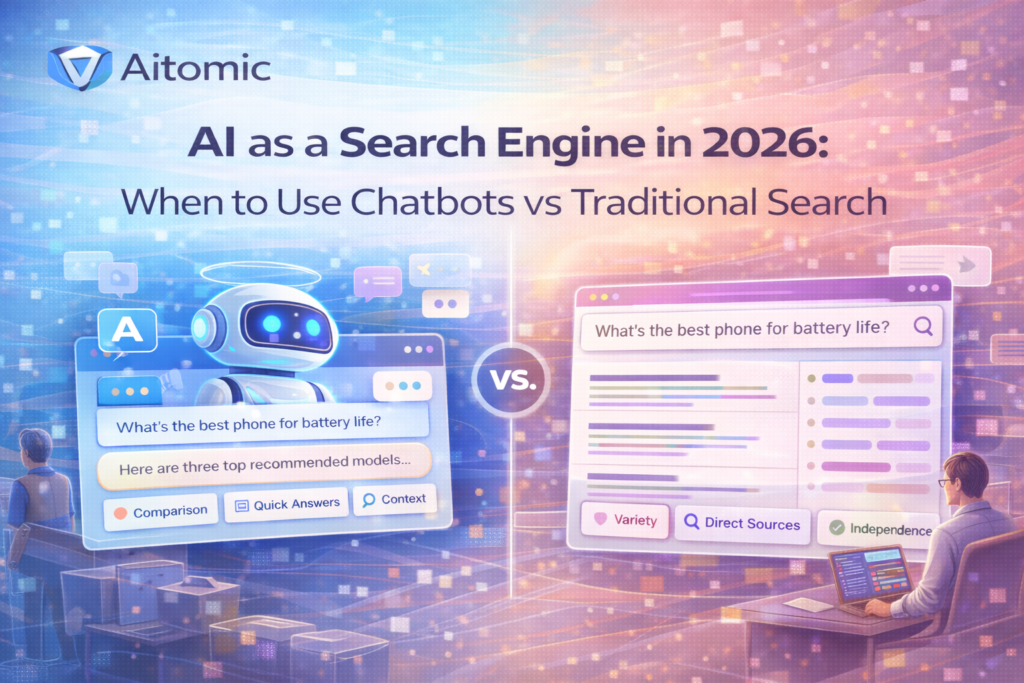
Traditional search is optimized for finding sources. AI chat tools are optimized for producing direct answers. For many everyday questions, people now prefer the speed and conversational style of AI responses.
This shift is strongest for synthesis tasks: explain this concept, compare these options, summarize this long page, or give me a starting plan.
It is weaker for tasks that require exact documents, current legal rules, or precise product specs unless the AI clearly cites and retrieves trustworthy sources.
When AI search is better than traditional search
AI search-style tools are excellent when you need translation, simplification, idea generation, or cross-source synthesis. They reduce time spent opening many tabs for straightforward questions.
They are also useful for iterative clarification: you can ask follow-ups, refine assumptions, and request different output formats without restarting the search process.
When traditional search still wins
Traditional search still wins when source fidelity matters: legal text, official pricing, regulations, product documentation, local business information, and time-sensitive news.
It also wins when you need to inspect multiple primary sources yourself, compare dates, or validate claims independently.
In practice, the strongest workflow is hybrid: use AI for synthesis, but verify key facts in primary sources.
What this means for publishers and SEO
Publishers need to produce content that is genuinely useful, source-aware, and structured for synthesis. Thin content can be summarized away. Original analysis, examples, and clear sourcing are harder to replace.
For websites, this means better topical coverage, stronger internal linking, better page quality, and clear evidence. The same traits that help readers also help AI systems find trustworthy material.
The goal is not to ‘beat AI search.’ It is to become a source AI and humans both trust.
How users can avoid AI search mistakes
Treat AI answers as a fast first pass, not the final authority. Ask for sources, verify important claims, and check dates on time-sensitive topics.
This matters even more in 2026 because usage is rising while concern about reliability remains significant.
For this guide, I treat survey responses and published ‘in their own words’ feedback as the closest thing to scalable testimony. That is more reliable than anonymous claims because readers can trace the source and see the original methodology.
How to evaluate AI search claims without overreacting
The most reliable way to use this guide is to treat it as a decision framework for AI as a search engine, not as a fixed prediction. AI markets, products, and public narratives move quickly, so your advantage comes from having a repeatable way to evaluate claims.
For this topic, start with a workflow-based test and a source-based verification pass. Separate trend narratives from task-level evidence, and verify the most important claims in primary sources before acting.
Common mistakes to avoid
- Using AI trend content as a decision shortcut without checking the underlying sources.
- Confusing search interest or social buzz with reliable evidence.
- Treating one tool, model, or headline as representative of the whole field.
What to monitor over the next 12 months
- Updates to primary reports, regulations, and official pricing pages.
- Shifts in user behavior (search, adoption, and trust patterns).
- Where practical workflow evidence contradicts popular online narratives.
Evidence interpretation: what the numbers really mean
Most AI articles list figures without explaining how to use them. This section translates the headline numbers into decision signals and shows where readers often overinterpret the data.
How to read the headline figures
Trend signal
Trend signal = Growing search interest in AI-answer workflows. Use this as a directional signal from Google Trends AI trend page, not as a standalone conclusion. The practical question is what behavior it should change in your workflow, budget, or risk controls.
Consumer behavior signal
Consumer behavior signal = Adobe reported large growth in AI chatbot referrals to retail sites. Use this as a directional signal from Adobe Analytics blog/report, not as a standalone conclusion. The practical question is what behavior it should change in your workflow, budget, or risk controls.
Public trust tension
Public trust tension = Concern remains high while usage grows. Use this as a directional signal from Pew Research (Apr 2025), not as a standalone conclusion. The practical question is what behavior it should change in your workflow, budget, or risk controls.
Hallucination risk
Hallucination risk = Needs source verification in high-stakes queries. Use this as a directional signal from NIST / OpenAI system-card examples, not as a standalone conclusion. The practical question is what behavior it should change in your workflow, budget, or risk controls.
How to interpret the evidence in this category
Behavior-shift data shows users are willing to get direct AI answers, but source-seeking remains essential for pricing, policy, legal text, and fast-changing topics.
For publishers, this means improving source quality and article structure rather than writing thinner summaries.
Detailed playbook: how to apply this in a real workflow
This is the implementation layer. The goal is to turn the topic into a repeatable workflow, pilot, or decision process you can run in the next 1-4 weeks.
Phase 1: Map the workflow and the risk
- Identify the exact workflow affected (research, drafting, search, support, triage, decision support).
- Define the highest-consequence failure mode (wrong fact, privacy leak, bad recommendation, overtrust).
- Set review requirements based on impact, not convenience.
Phase 2: Build a bounded process
- Create an approved tool list and task-specific examples.
- Require evidence or source checks for factual outputs where appropriate.
- Teach users what AI can do in this workflow and what requires escalation.
Phase 3: Measure and improve
- Track cycle time, quality, and rework together.
- Review incidents/failures monthly and update prompts plus process controls.
- Re-audit the workflow when tools, policies, or stakes change.
Context matters: AI search is not one workflow
Individual user
Your main leverage is verification discipline and source quality. Your main risk is overtrust or oversharing while trying to move fast.
Small business
Keep the system simple: approved tools, clear use cases, and lightweight review rules. Complexity slows adoption and increases shadow usage.
Enterprise or regulated team
Auditability, permissions, and incident handling become part of the product. Workflow design around the model matters as much as the model itself.
Practical examples
These are decision-oriented examples to help you apply the topic in a real workflow instead of treating AI as a generic trend.
- Good AI-search use case: Ask for a plain-English explanation of a complex topic, then verify the recommended sources.
- Bad AI-search use case: Rely on an uncited AI answer for current product pricing or legal requirements.
- Hybrid research workflow: Use AI to build a comparison framework, then fill it with numbers from official sources.
- Publisher strategy: Create articles with original analysis and clear source links so both users and AI can verify claims.
Next-step checklist
- Use AI search for synthesis and explanation, not blind trust.
- Verify dates, numbers, pricing, and policy claims in primary sources.
- Ask AI to cite sources and state uncertainty.
- Use a hybrid workflow for high-stakes research.
- If you publish online, invest in source-rich, high-utility pages.
FAQs
Will AI replace Google search completely?
Not completely. AI answer tools and traditional search serve different strengths, and many users will use both.
What is the biggest risk of AI as search?
Confidently wrong answers presented as complete facts, especially without visible sources.
How should websites adapt?
Publish more useful, source-backed, clearly structured content with strong internal linking and original analysis.
Research notes and sources
This article was written as a practical guide using public reports, official documentation, and pricing pages. Pricing and product features can change; verify current details on the official pages before acting.
Figure sources used in this article
- Trend signal: Google Trends AI trend page
- Consumer behavior signal: Adobe Analytics blog/report
- Public trust tension: Pew Research (Apr 2025)
- Hallucination risk: NIST / OpenAI system-card examples
Why these sources were used
- Google Trends (US) – Artificial Intelligence Search Trends (https://trends.withgoogle.com/trends/us/artificial-intelligence-search-trends/?hl=en-US) – Trend exploration for the user’s market context (United States).
- Adobe – AI chatbots and shopping/search behavior (Adobe Analytics) (https://business.adobe.com/blog/the-latest/ai-chatbots-are-becoming-consumers-go-to-for-search-and-shopping) – Used for AI-as-search behavior change evidence (verify metrics on page at publish time).
- Pew Research Center – How Americans view AI and its impact (2025) (https://www.pewresearch.org/short-reads/2025/04/03/how-americans-view-ai-and-its-impact-on-people-and-society/) – Used for public sentiment and concern/excitement balance.
- NIST – Reducing Hallucinations in Generative AI Applications (Pilot Profile) (https://www.nist.gov/publications/reducing-hallucinations-generative-ai-applications-pilot-ai-profile) – Used for hallucination risk-reduction practices.
- OpenAI – OpenAI o1 System Card (https://openai.com/index/openai-o1-system-card/) – Used as an example of model hallucination benchmarking disclosure.
- Google Trends (US) – Artificial Intelligence Search Trends
- Adobe – AI chatbots and shopping/search behavior (Adobe Analytics)
- Pew Research Center – How Americans view AI and its impact (2025)
- NIST – Reducing Hallucinations in Generative AI Applications (Pilot Profile)
- OpenAI – OpenAI o1 System Card
Explore More on Aitomic
Related reads
- Adobe Firefly Review (2026): Pricing, Features, Pros & Cons
- AI and Data Privacy Risks in 2026: What Happens to Your Data and How to Use AI More Safely
- AI and Job Displacement in 2026: What Changes First, What Grows, and How to Adapt
- AI for Mental Health Support in 2026: What It Can Help With, What It Cannot Replace
- Amazing Selling Machine Review (2026): Pricing, Features, Pros & Cons
- Best AI for Coding in 2026: How to Compare Tools for Real Development Work
Pingback: Best AI for Coding in 2026: How to Compare Tools for Real
Pingback: What Is Artificial Intelligence? A Practical 2026 Guide
Pingback: How AI Is Used at Work for Productivity in 2026 (With Real
Pingback: Best AI for Writing in 2026: How to Choose Tools for
Pingback: AI vs. Machine Learning vs. Deep Learning: What’s the
Pingback: AI and Job Displacement in 2026: What Changes First, What