
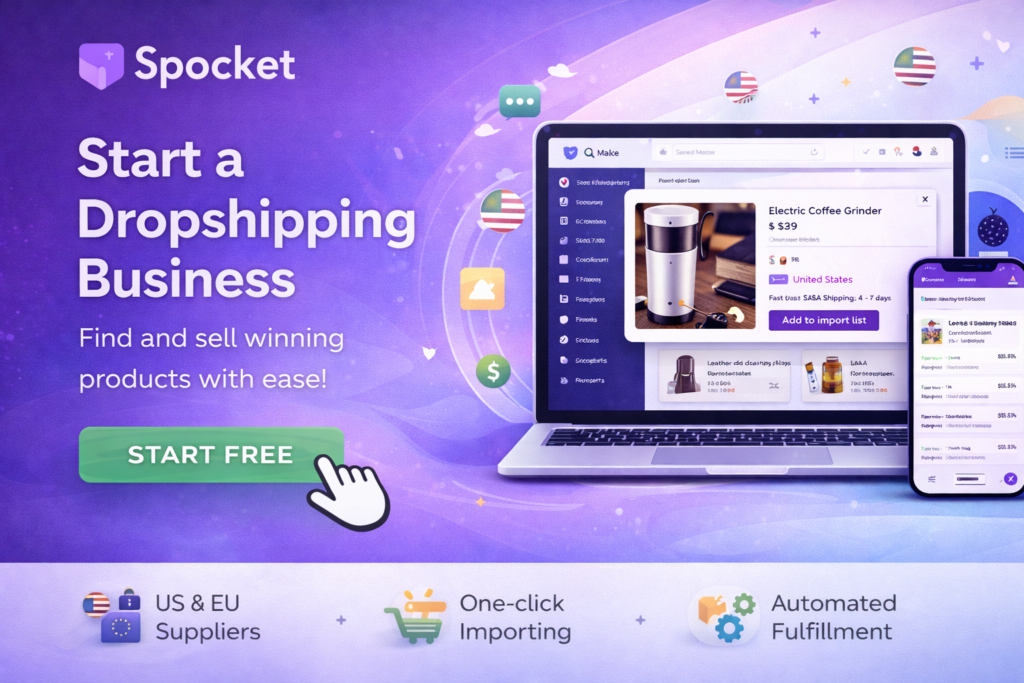
Quick scan before you read the full review
Quick verdict
Dropshipping enablement platform with strong interest from new ecommerce operators seeking faster supplier setup.
Best for
- Launching a dropshipping catalog quickly
- Syncing supplier products into a store
- Testing products before holding inventory
Watch-outs
- Supplier quality and delivery times still require vetting
- Margins can shrink in competitive products
| Category | Website & Automation Tools |
| Seller | Spocket |
| Price snapshot | $40 (recurring) |
| Review lens | Buyer fit, workflow fit, total cost, tradeoffs |
If you’re researching Spocket, the biggest mistake is buying based on the headline promise before checking whether the workflow actually fits how your team works day to day. Spocket can be a strong option, but only for the right use case.
This review is written for new ecommerce founders and store operators testing dropshipping offers who want a practical breakdown of what they are paying for, where the value comes from, and what tradeoffs to expect before committing.
What is Spocket best for?
Spocket is best if you want to:
- launching a dropshipping catalog quickly.
- Syncing supplier products into a store.
- Testing products before holding inventory.
Key features (what you’re actually paying for)
Based on the product positioning and buyer workflows this category targets, you are mainly paying for:
- Dropshipping platform for sourcing products and syncing suppliers with ecommerce storefronts.
- Workflow speed / convenience compared with stitching together multiple tools.
- Ongoing support, infrastructure, or platform maintenance (depending on plan).
- Reduced setup friction for the main job the buyer is trying to get done.
Pricing (reality check)
It is a recurring subscription category (Utila placeholder price snapshot: about $40/month), but plan features, seats/usage limits, and billing cycle discounts change often.
Always confirm the latest plan names, limits, and billing rules on the official pricing page before publishing final numbers.
It may be worth the cost if the tool saves time, increases output consistency, or replaces multiple tools/services in your workflow.
Common complaints
Supplier quality and delivery times still require vetting.
Margins can shrink in competitive products.
Another common issue is mismatch, not quality: buyers expect a different workflow than what the product is designed for.
Who should NOT buy Spocket:
Spocket is probably not for you if:
- You only need the outcome occasionally and can use a cheaper alternative or freelancer.
- Your workflow requires advanced customization the platform is not designed to prioritize.
- You have not mapped the total cost (tool + add-ons + execution time + other software).
Verdict
Dropshipping enablement platform with strong interest from new ecommerce operators seeking faster supplier setup.
Spocket helps ecommerce operators source and sync dropshipping products faster, but success still depends on product selection, supplier quality, and margin discipline.
My recommendation:
- Spocket is a good fit for new ecommerce founders and store operators testing dropshipping offers when the priority is launching a dropshipping catalog quickly.
- Do a quick workflow test first, then compare total cost against alternatives before committing to a longer billing cycle.
- Use the Utila summary for quick comparison, then use the full aitomic article for the final buy/no-buy decision.
FAQs
Is Spocket good for beginners? It can be, if the buyer’s main need matches the core workflow. The biggest mistake is buying it before defining the exact use case and total cost.
How much does Spocket cost? Pricing and plan structure change, so confirm the latest details on the official site before publishing exact figures. Start by checking which plan limits matter for your workflow.
What is the main downside of Spocket? The most common issue is supplier quality and delivery times still require vetting. Buyers usually feel this most when they choose based on marketing claims instead of workflow fit.
How Buyers In This Category Should Evaluate It
Website and automation tools usually win on convenience early, then get judged on reliability later. Spocket is worth evaluating based on how stable it remains as workflows, traffic, or integrations grow.
Before you commit, define the job Spocket is supposed to improve. That keeps the review practical and makes the buying decision easier to defend later.
What It Feels Like In A Real Workflow
Spocket usually delivers the most value when it is placed inside a clear site and operations workflow rather than treated as a one-click fix. Teams that get strong results from tools like this typically start with one repeatable use case, document the process, and expand only after the output quality is proven.
When you evaluate Spocket, try to ignore feature-count marketing for a moment. The more useful question is whether it helps your team complete the main job faster and with fewer mistakes. In practice, the most meaningful signal is less manual work and fewer operational bottlenecks.
Best-Fit Scenarios (Where It Usually Pays Off)
- Spocket is easier to justify if your immediate goal is launching a dropshipping catalog quickly, because the workflow benefit is measurable.
- Spocket is easier to justify if your immediate goal is syncing supplier products into a store, because the workflow benefit is measurable.
- Spocket is easier to justify if your immediate goal is testing products before holding inventory, because the workflow benefit is measurable.
What To Check In Your Trial Before You Commit
- Run the exact workflow you plan to use after purchase, not a demo-only scenario.
- Check integration reliability, scaling limits, and what breaks when usage grows early, because those factors usually decide long-term satisfaction.
- The current snapshot in this workflow is around $40, but plan limits and billing terms can change, so treat it as a comparison starting point, not a final quote.
- Compare against your current process (or one alternative) using time saved, output quality, and total cost.
A good trial for Spocket should end with a clear decision: keep it, downgrade it, or choose a simpler alternative. If the value only appears in hypothetical future use cases, it is usually too early to commit.
Implementation Reality (First 30 Days)
The first month is where expectations get corrected. In many cases, the issue is not that Spocket is poor quality; it is that initial setup looks simple while long-term maintenance is the real cost. This is why phased rollout tends to work better than company-wide rollout on day one.
- Start with one owner and one repeatable workflow.
- Document naming conventions, templates, and process decisions immediately.
- Review output quality weekly before expanding to more people or use cases.
- Plan around this tradeoff from the start: supplier quality and delivery times still require vetting.
How To Compare Alternatives More Honestly
Compare Spocket to alternatives using the same real task and the same scoring criteria. This gives a more useful decision than comparing feature tables or pricing pages in isolation.
- Time the setup plus completion of the same task in two tools.
- Judge the quality of the output your team would actually use or publish.
- Include hidden costs: seats, add-ons, usage limits, training time, and rework.
Bottom-Line Buying Advice
Spocket is most likely to be worth it when you already know the exact job it needs to do and can measure whether it improves that workflow. If you are still figuring out the process itself, test smaller, decide faster, and avoid long commitments based only on brand reputation or feature volume.
If reliability and operational simplicity are priorities, Spocket can be a strong fit when you test the workflows you will actually run. Long-term maintainability should matter as much as setup speed.
Explore More Reviews
Browse more tools in Website & Automation Tools or jump to related reviews to compare features, pricing, and fit.